Prodigy
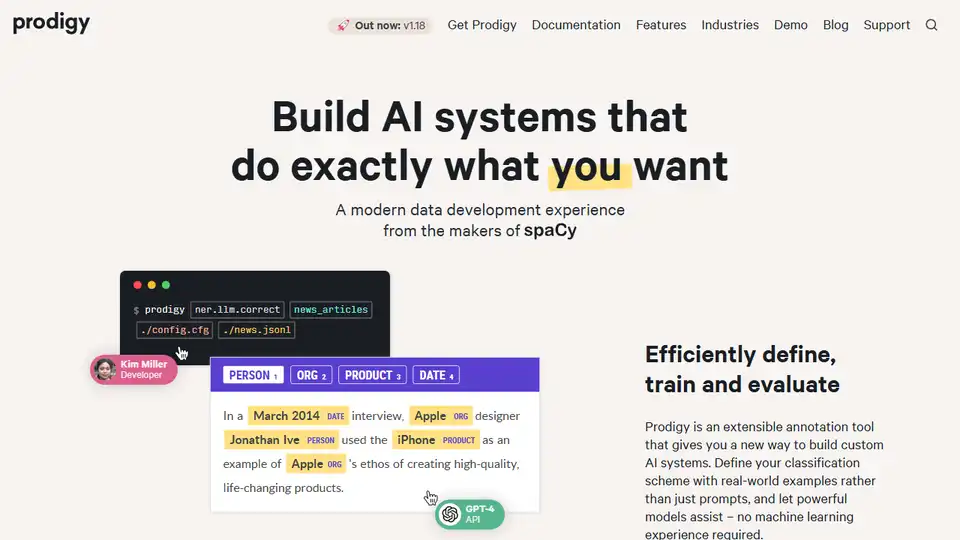
Overview of Prodigy
What is Prodigy?
Prodigy is an extensible annotation tool designed for AI, Machine Learning, and NLP tasks. It provides a modern data development experience, allowing users to build custom AI systems efficiently. Prodigy is particularly useful for tasks such as named entity recognition, text classification, object detection, image segmentation, and more.
Key Features of Prodigy
- Information Extraction: Get structured data from text.
- Language Model Training: Train and fine-tune models.
- Computer Vision: Classify and segment images.
- Audio & Video: Classify and segment AV data.
- Prompt Engineering: Develop better LLM prompts.
- Custom Workflows: Fully customize your experience.
How does Prodigy work?
Prodigy runs entirely under your control, making it suitable for even the strictest privacy requirements. You can download it and run it locally right out of the box, or adapt it to serve your infrastructure needs. The models you produce are yours as well, with absolutely no lock-in.
How to use Prodigy?
- Define Your Classification Scheme: Use real-world examples rather than just prompts.
- Leverage Powerful Models: Let powerful models assist in your tasks.
- Customize Data Feeds and Interfaces: Break down tasks into smaller pieces and automate whatever you can.
Why choose Prodigy?
- Privacy: Runs entirely on your own machines, ensuring full privacy.
- Customization: Fully customizable data feeds and interfaces.
- Efficiency: Make annotation over 10× as efficient.
- Flexibility: Flexible options for individuals and teams.
Who is Prodigy for?
Prodigy is ideal for developers, data scientists, researchers, and anyone involved in AI, Machine Learning, and NLP tasks. It is particularly useful for industries such as banking & finance, healthcare & biomedical, media & content creation, legal & insurance, and more.
Best way to use Prodigy?
The best way to use Prodigy is to leverage its powerful built-in workflows and customization options. By defining your classification schemes with real-world examples and automating tasks, you can significantly improve the efficiency and accuracy of your AI systems.
Real-world Case Studies
- S&P Global: Makes markets more transparent with spaCy and Prodigy in a high-security environment.
- The Guardian: Approaches quote extraction from news articles with spaCy and Prodigy.
- Nesta: Processes 7m job ads to shed light on the UK’s labor market with spaCy and Prodigy.
- Love Without Sound: Helps music industry law firms recover millions with spaCy and Prodigy.
- Posh: Deploys a customized Prodigy cloud service to build financial chatbots for banking conversations.
What others say
- Christopher Ewen: "Having a small model makes it much easier to achieve our strict inference SLAs. The system is much less operationally complex because the model is so efficient. Prodigy lets us automate as much as possible and focus on valuable decisions and less clicking."
- Andy Halterman: "A lack of labeled data held geoparsing back for years. It took a week to fix that with Prodigy."
- India Kerle: "Our current work on measuring the greenness of jobs at the skill-, occupation- and industry-level relied heavily on Prodigy’s flexible custom recipes to incorporate Large Language Models (LLMs) in the labeling process."
- Anna Vissens: "The principle of human-in-the-loop machine learning is everywhere in journalism. For our AI projects, our data science team developed a fully customized hybrid rules and model-based annotation workflow with Prodigy."
- Cheyanne Baird: "Prodigy’s design aspect was key. [With my previous annotation tools], I would get a lot of feedback from annotators, saying ‘it’s really hard, because I have to scroll and scroll and scroll to see the labels. There’s too many labels. There’s too many options.’ When I was looking at Prodigy I liked it because you could customize it."
- Raphael Cohen: "Prodigy is by far the best ROI we had on any tool!"
- Daniel Bourke: "We love Prodigy! I've tried many data labelling tools and chose Prodigy specifically for the simplicity. Image folder plus text file to database is perfect for our needs. If a model is one of our main products, good data is basically the same as good code."
- Antonio Polo de Alvarado: "I have been working with Prodigy these last few weeks and I can say that it is probably (if not the best) one of the best NLP tools."
- Rebecca Bilbro: "Prodigy’s interface is incredibly intuitive! It elevates data labeling to a first-order concern in the ML workflow, enables us to collaborate on measures of inter-rater reliability and makes the labeling options super unambiguous for data annotators."
- User Survey Participant: "I really love being able to do almost everything in Python, it means that team members with no front end experience can create tasks super easily."
- Jordan Davis: "What I love about Prodigy is that it makes it really easy to try out ideas. You often don't know whether something works until you try it. Prodigy lets me iterate on my label schemes and definitions, and build much better models this way."
Frequently Asked Questions
- What makes Prodigy different from other annotation solutions?: Prodigy is highly customizable and runs entirely on your own machines, ensuring full privacy and control.
- Is our data really private? How does it work?: Yes, Prodigy runs locally, ensuring that your data never leaves your servers.
- Which models can I use and train with Prodigy?: Prodigy supports a wide range of models for various tasks, including named entity recognition, text classification, object detection, and more.
- How customizable are Prodigy’s workflows and interfaces?: Prodigy allows for fully customizable data feeds and interfaces, making it highly adaptable to your specific needs.
- What expertise does my team need to use Prodigy?: Prodigy is designed to be user-friendly and does not require extensive machine learning experience.
- Which cloud providers does Prodigy support?: Prodigy can be adapted to serve your infrastructure needs, including various cloud providers.
- Do you have special offers for researchers and universities?: Yes, Prodigy offers flexible options for researchers and universities.
Conclusion
Prodigy is a powerful and versatile annotation tool that is ideal for AI, Machine Learning, and NLP tasks. Its customizable workflows, privacy features, and efficiency make it a top choice for developers, data scientists, and researchers. Whether you are working on named entity recognition, text classification, object detection, or any other AI-related task, Prodigy provides the tools and flexibility you need to succeed.
Tags Related to Prodigy