ESG Analytics
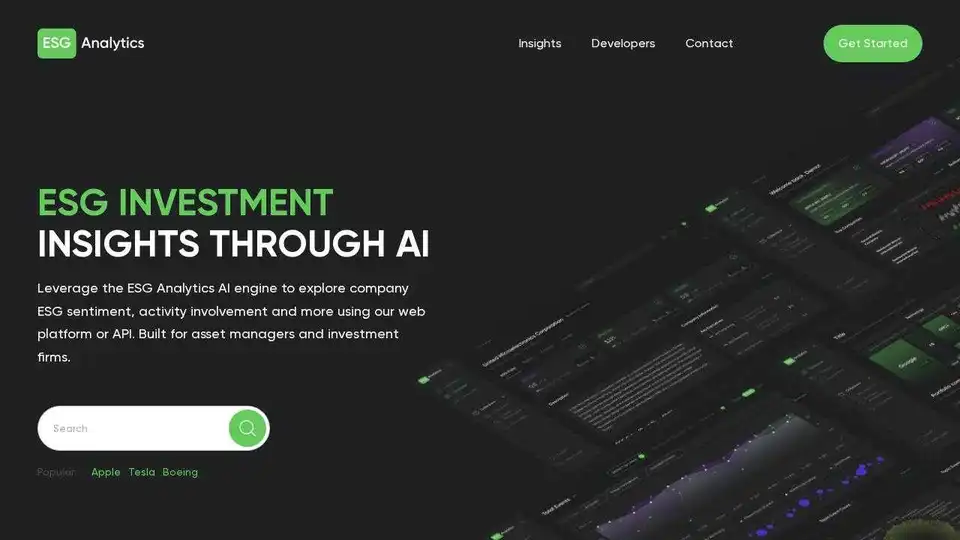
Overview of ESG Analytics
ESG Analytics: AI-Powered ESG Insights for Investment Decisions
What is ESG Analytics? ESG Analytics is a platform that leverages artificial intelligence (AI) to provide real-time ESG (Environmental, Social, and Governance) scores and ratings for companies globally. It is designed for asset managers, investment firms, and other financial professionals seeking to integrate ESG factors into their investment processes.
How does ESG Analytics work? The ESG Analytics AI Engine aggregates data from over 100,000 sources, including news, PR, and opinions. It then extracts over 1,000,000 data points per month, analyzes 300,000 signals, and generates four key scores for 26 ESG categories. This provides a comprehensive and up-to-date view of a company's ESG performance.
Key Features and Benefits:
- Real-time ESG Scores and Ratings: Provides up-to-date information on company ESG performance.
- AI-Powered Analysis: Uses Natural Language Processing (NLP) to identify ESG-relevant signals from unstructured text.
- Comprehensive Data Coverage: Aggregates data from a wide range of sources.
- ESG Pulse: A sentiment analysis model that scores ESG signals on a scale of -1 to +1.
- Historical Data: Provides 5+ years of history for global companies.
Use Cases:
ESG Analytics supports various workflows for different types of users:
- Asset Managers:
- Idea Generation and Portfolio Construction
- Composite Scoring
- Portfolio Analysis, Alerts, and Reporting
- Company and Industry Research
- Asset Owners:
- Manager Selection and Monitoring
- Investor Inquiry Management
- Portfolio Analysis, Alerts, and Reporting
- Quantitative Managers:
- ESG Risk Premia Incorporation
- Proprietary ESG Score Creation
- Risk Management
- Risk and Compliance:
- Due Diligence
- Research and Monitoring
- Portfolio Risk Management
- Sell Side:
- Due Diligence
- Research Creation
- Portfolio Analysis, Alerts, and Reporting
Technology:
The ESG Analytics AI Engine uses NLP to understand which pieces of text count as 'ESG relevant' and extract signals. The 'ESG Pulse' score is generated using ESG-specific sentiment analysis models.
Why is ESG Analytics important? Integrating ESG factors into investment decisions is becoming increasingly important. ESG Analytics provides a data-driven and efficient way to assess ESG risks and opportunities.
Where can I use ESG Analytics? You can use ESG Analytics through its web platform or API. It is suitable for asset managers, investment firms, asset owners, wealth managers, consultants, and other financial professionals.
Testimonials:
Here's what users are saying about ESG Analytics:
- Manuel H (CEO - Asset Manager): "This is a future of ESG - real time information, from things outside of what companies disclose. This helps us keep on track."
- James T (Portfolio Manager): "The ESG Pulse is a direct metric in our screening process and goes hand in hand with fundamental factors".
- Clair D (ESG Consultant): "We used ESG Analytics to complement our existing research process. Their AI powered analysis provided an 'outside-in' view for the companies we analysed."
In conclusion, ESG Analytics provides valuable insights into company ESG performance using AI-powered analysis, helping investors make more informed decisions. By aggregating and analyzing vast amounts of data, it offers a comprehensive and real-time view of ESG risks and opportunities.
Tags Related to ESG Analytics