MDLR
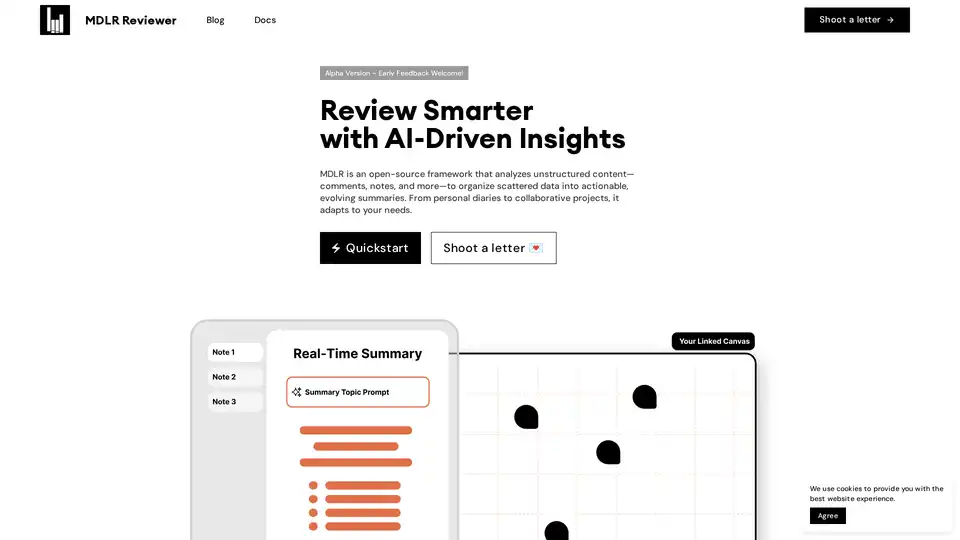
Overview of MDLR
What is MDLR?
MDLR is an innovative open-source framework designed to revolutionize how we handle unstructured content. Whether it's scattered comments, personal notes, feedback from users, or disconnected ideas in collaborative projects, MDLR uses AI-driven insights to transform this chaos into actionable, evolving summaries. Unlike traditional static AI tools that generate one-off responses, MDLR creates ongoing, auto-updating summary notes that stay fresh as new data streams in. This makes it perfect for personal diaries, team reviews, or any platform needing intelligent content organization.
Launched by the MDLR team as an alpha version welcoming early feedback, it's positioned as a versatile extension you can integrate into your own platforms. Imagine embedding it into project management tools, note-taking apps, or feedback systems to unlock real-time intelligence from messy data.
Key Features of MDLR
MDLR stands out with several core capabilities that address common pain points in data management:
- Real-Time Analysis of Unstructured Data: Processes comments, notes, diaries, and more without rigid structures, identifying key themes and insights dynamically.
- Evolving Summaries: Summaries update automatically with incoming data, ensuring relevance—no more outdated reports.
- Full User Control: Customize AI behaviors to fit your workflow, avoiding black-box experiences.
- Easy Integration: Deploy as an extension in your platform, supporting personal and collaborative environments.
- Open-Source Flexibility: Freely modify and extend under its license (details in docs), fostering community contributions.
These features make MDLR a go-to for anyone tired of manual sorting or inefficient reviews.
How Does MDLR Work?
At its heart, MDLR leverages advanced AI models—likely drawing from large language models (LLMs) similar to those powering ChatGPT or Claude—to parse and synthesize unstructured text. Here's a step-by-step breakdown:
- Input Ingestion: Feed in raw data like email threads, Slack comments, or journal entries.
- AI Processing: The framework applies natural language processing (NLP) techniques to extract entities, sentiments, and patterns.
- Summary Generation: Builds hierarchical, actionable notes that evolve—e.g., a project feedback summary might highlight top issues, resolutions, and trends.
- Auto-Updates: As new content arrives (via APIs or uploads), it incrementally refines summaries without full regenerations.
- Output Delivery: Accessible via your integrated UI, with options for export or visualization.
This continuous learning loop mimics human review processes but scales effortlessly. For developers, quickstart guides and docs simplify setup, often just a few lines of code to "shoot a letter" (their fun demo term for testing).
How to Use MDLR?
Getting started is straightforward:
- Clone the Repo: Access via official sources (check MDLR's GitHub or site for links).
- Install Dependencies: Standard open-source setup with Python/Node.js support implied.
- Quickstart Demo: Use the "Shoot a letter 💌" feature to test with sample notes.
- Integrate: Embed as a browser extension, app plugin, or backend service.
- Customize: Tweak prompts and models for domain-specific needs, like software dev feedback or creative writing reviews.
Common queries from the page, like licensing (open-source, specifics in docs), database usage (likely for persistence), and public access (alpha now, expanding soon), are addressed in their docs and blog.
Why Choose MDLR?
In a world drowning in information overload, MDLR offers efficiency and adaptability. Static tools like basic summarizers fail when data evolves; MDLR doesn't. It's free (open-source), extensible, and user-centric—ideal for indie devs, startups, or enterprises building smarter apps.
Practical Value:
- Saves Time: Automate what takes hours manually.
- Boosts Collaboration: Teams get unified insights from fragmented inputs.
- Scales Seamlessly: Handles growing data volumes without performance dips.
Compared to proprietary alternatives like Notion AI or Otter.ai, MDLR's open nature avoids vendor lock-in and costs.
Who is MDLR For?
- Individuals: Journalers, researchers organizing notes.
- Teams: Product managers reviewing user feedback, writers refining drafts.
- Developers: Building AI-enhanced platforms in built environments (per their tagline).
- Educators: Summarizing student comments or lesson feedback.
Early adopters in alpha are providing feedback, shaping its roadmap.
Real-World Use Cases
- Project Reviews: Turn GitHub issues and PR comments into evolving status reports.
- Personal Knowledge Management: Evolve daily journals into thematic insights.
- Customer Feedback Loops: Aggregate support tickets into trend summaries for product roadmaps.
- Content Creation: Organize brainstorm notes for blogs or reports.
In industry contexts, tools like MDLR align with the rise of agentic AI workflows, where summaries feed into decision engines. With growing unstructured data (projected to hit 90% of all data by 2025 per IDC), its timing is spot-on.
Best Way to Get Started with MDLR
Head to their docs for quickstart, join the alpha for feedback, and experiment. As an open-source project under MDLR Limited (2024 copyright), expect rapid iterations based on community input.
MDLR isn't just a tool—it's a smarter way to review and build with AI. Integrate it today for insights that evolve with you.
Tags Related to MDLR