LMQL: A Programming Language for LLM Interaction

LMQL

3.5 | 291 | 0
Type:
Open Source Projects
Last Updated:
2025/10/15
Description:
LMQL is a programming language for LLMs, enabling robust prompting with types, templates, and constraints. It supports multiple backends and offers features like nested queries and Python integration.
Share:
LLM programming
prompt engineering
constrained generation

Overview of LMQL

What is LMQL?

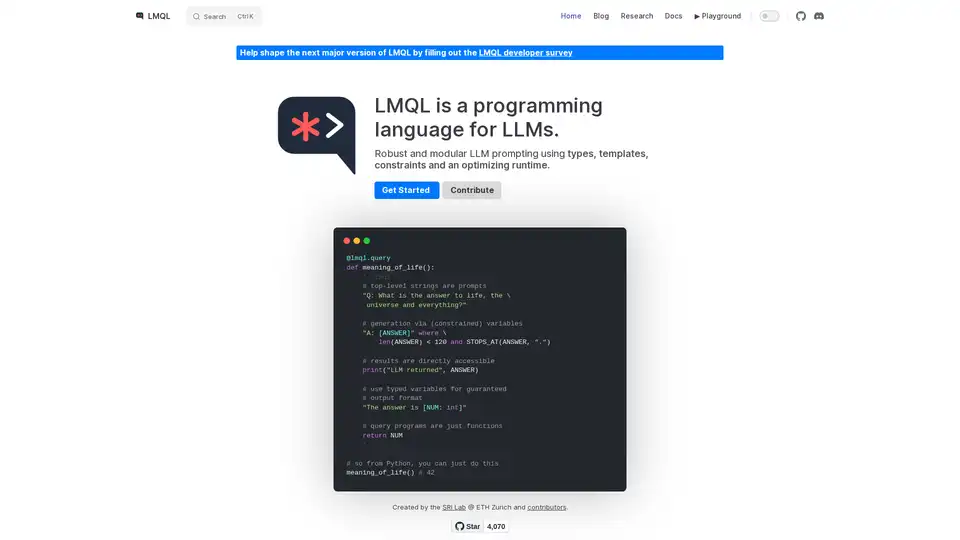
LMQL (Language Model Query Language) is a programming language specifically designed for interacting with Large Language Models (LLMs). It provides a robust and modular approach to LLM prompting, leveraging types, templates, constraints, and an optimizing runtime to ensure reliable and controllable results. LMQL aims to bridge the gap between traditional programming paradigms and the probabilistic nature of LLMs, enabling developers to build more sophisticated and predictable AI applications.

How does LMQL work?

LMQL operates by allowing developers to define prompts as code, incorporating variables, constraints, and control flow. This approach contrasts with traditional string-based prompting, which can be less structured and harder to manage. Here's a breakdown of key LMQL features:

  • Typed Variables: LMQL allows you to define variables with specific data types (e.g., int, str), ensuring that the LLM's output conforms to the expected format. This feature is crucial for building applications that require structured data.
  • Templates: LMQL supports templates, enabling the creation of reusable prompt components. Templates can be parameterized with variables, making it easy to generate dynamic prompts.
  • Constraints: LMQL allows you to specify constraints on the LLM's output, such as maximum length or specific keywords. These constraints are enforced by the LMQL runtime, ensuring that the LLM's response meets your requirements.
  • Nested Queries: LMQL supports nested queries, allowing you to modularize your prompts and reuse prompt components. This feature is particularly useful for complex tasks that require multiple steps of interaction with the LLM.
  • Multiple Backends: LMQL can automatically make your LLM code portable across several backends. You can switch between them with a single line of code.

Example

@lmql.query
def meaning_of_life():
    '''lmql
    # top-level strings are prompts
    "Q: What is the answer to life, the \
     universe and everything?"

    # generation via (constrained) variables
    "A: [ANSWER]" where \
        len(ANSWER) < 120 and STOPS_AT(ANSWER, ".")

    # results are directly accessible
    print("LLM returned", ANSWER)

    # use typed variables for guaranteed 
    # output format
    "The answer is [NUM: int]"

    # query programs are just functions 
    return NUM
    '''

## so from Python, you can just do this
meaning_of_life() # 42

How to use LMQL?

  1. Installation:

    Install LMQL using pip:

    pip install lmql
    
  2. Define Queries:

    Write LMQL queries using the @lmql.query decorator. These queries can include prompts, variables, and constraints.

  3. Run Queries:

    Execute LMQL queries like regular Python functions. The LMQL runtime will handle the interaction with the LLM and enforce the specified constraints.

  4. Access Results:

    Access the LLM's output through the variables defined in your LMQL query.

Why choose LMQL?

  • Robustness: LMQL's types and constraints help ensure that the LLM's output is reliable and consistent.
  • Modularity: LMQL's templates and nested queries promote code reuse and modularity.
  • Portability: LMQL works across multiple LLM backends, allowing you to easily switch between different models.
  • Expressiveness: LMQL's Python integration allows you to leverage the full power of Python for prompt construction and post-processing.

Who is LMQL for?

LMQL is suitable for developers who want to build AI applications that require precise control over LLM behavior. It is particularly useful for tasks such as:

  • Data extraction: Extracting structured data from text.
  • Code generation: Generating code based on natural language descriptions.
  • Chatbots: Building chatbots with predictable and consistent responses.
  • Question answering: Answering questions based on structured knowledge.

By using LMQL, developers can build more reliable, modular, and portable AI applications that leverage the power of LLMs.

Best way to use LMQL is to check documentation and start with simple example, then gradually increase complexity of prompts to suit you needs.

Best Alternative Tools to "LMQL"

Lunary
No Image Available
235 0

Lunary is an open-source LLM engineering platform providing observability, prompt management, and analytics for building reliable AI applications. It offers tools for debugging, tracking performance, and ensuring data security.

LLM monitoring
AI observability
Paird.ai
No Image Available
409 0

Paird.ai is a collaborative AI code generation platform that allows teams to rapidly build prototypes and solve problems using nodes and simple intentions. Features include multiple LLM support, AI code scoring, and real-time collaboration.

AI code assistant
GPT Prompt Lab
No Image Available
383 0

GPT Prompt Lab is a free AI prompt generator that helps content creators craft high-quality prompts for ChatGPT, Gemini, and more from any topic. Generate, test, and optimize prompts for blogs, emails, code, and SEO content in seconds.

prompt generation
Query Vary
No Image Available
241 0

Query Vary is a no-code platform that allows teams to collaboratively train AI and build AI-powered automations. It integrates generative AI to optimize workflows and enhance productivity without programming.

no-code AI
workflow automation
Prompt Engineering Institute
No Image Available
363 0

The Prompt Engineering Institute provides AI insights, prompt engineering strategies, training, and resources for real-world AI applications. Stay ahead in AI.

AI training
prompt engineering
LLM
Vibe Coding
No Image Available
472 0

Discover Vibe Coding, a platform with AI coding tools to generate code using natural language. Explore top AI tools and expert guides to build projects faster.

AI code generation
Weco AI
No Image Available
360 0

Weco AI automates machine learning experiments using AIDE ML technology, optimizing ML pipelines through AI-driven code evaluation and systematic experimentation for improved accuracy and performance metrics.

ML automation
code optimization
BuildOwn.AI
No Image Available
331 0

BuildOwn.AI: A developer's guide to building real-world AI applications using large language models (LLMs).

AI development
LLM
TypeScript
Magic Loops
No Image Available
397 0

Magic Loops is a no-code platform that combines LLMs and code to build professional AI-native apps in minutes. Automate tasks, create custom tools, and explore community apps without any coding skills.

no-code builder
AI app creation
16x Prompt
No Image Available
488 0

16x Prompt is an AI coding tool for managing code context, customizing prompts, and shipping features faster with LLM API integrations. Ideal for developers seeking efficient AI-assisted coding.

AI code generation
prompt management
llmarena.ai
No Image Available
465 0

Compare AI models easily! All providers in one place. Find the best LLM for your needs with our comprehensive pricing calculator and feature comparison tool. OpenAI, Anthropic, Google, and more.

LLM comparison
AI pricing calculator
BAML
No Image Available
255 0

BAML is an open-source toolkit for building type-safe and reliable AI applications. Use BAML to define, test, and deploy AI agents with confidence. Perfect for developers aiming for high reliability in their AI pipelines.

AI development
LLM
type-safe
Predict Expert AI
No Image Available
349 0

Predict Expert AI empowers businesses with tailored AI models and intelligent applications, driving efficiency, streamlining operations, and increasing profitability. Get real-time insights and revolutionize your business with AI.

AI solutions
business automation
DeepSeek Nederlands
No Image Available
378 0

Experience seamless AI chat with DeepSeek Nederlands, powered by the advanced DeepSeek-V3 model. Use it for any task, completely free and without registration!

AI assistant
language model
NLP