What Is an AI Agent? How Autonomous AI Agents Work and Where They Are Used
An AI Agent is an artificial intelligence system capable of autonomously planning tasks, calling tools, and executing multi-step actions based on specific goals. By leveraging Large Language Models (LLMs) to understand requirements and plan objectives, its core characteristics—proactive reasoning and cross-tool operational capabilities—distinguish it from traditional AI systems that rely on preset instructions. AI Agents are pushing generative AI from simple chat dialogues into a new stage of autonomous execution.
Recently, Meta released an impressive series of videos showcasing an AI agent named "Cicero." It can not only understand human strategic intent in games but also proactively negotiate with other players, build alliances, and ultimately win.
The multi-agent collaboration system behind AI Agents can simulate human behavior in complex social environments. This is a landmark advancement: AI is no longer just a passive respondent but an autonomous entity capable of actively planning and executing complex tasks.
This article introduces what AI Agents are, their history, technical frameworks, workflows, application scenarios, and case studies.
Target Audience:
- Tech enthusiasts and entry-level learners
- Professionals and managers seeking productivity gains
- Enterprise decision-makers and business leaders
- General users interested in future AI trends
Table of Contents:
- 01 What is an AI Agent?
- 02 The Evolution of AI Agents
- 03 What is the Difference Between an AI Agent and a Standard Chat AI?
- 04 What Are the Core Components of an AI Agent Architecture? AI Agent Architecture Analysis
- 05 How Do AI Agents Make Autonomous Decisions? From Abstract to Concrete Execution
- 06 What are the best AI agent frameworks? Comparison of Major AI Agent Frameworks
- 07 What Are AI Agents Used For? Real-World AI agent use cases
- 08 Current Challenges and Strategies
- 09 Future Trends and Value for Individuals
- 10 Frequently Asked Questions (FAQ)
01 What is an AI Agent?
An AI Agent is an AI software system that uses artificial intelligence to achieve autonomous task planning, tool invocation, and task execution to reach a goal. It goes beyond understanding and generating natural language; it possesses the ability to perceive its environment, make decisions, and take actions.
Unlike traditional chat AI, which only responds to questions, an AI Agent can orchestrate resources, collaborate with other agents, and utilize various tools such as Large Language Models (LLM), Retrieval-Augmented Generation (RAG), Vector Databases, APIs, frameworks, and high-level programming languages like Python.
Imagine telling an AI Agent: "Analyze last week's sales data and create a PPT report." It would autonomously perform the following: fetch data, clean and analyze it, generate charts, write key takeaways, and finally format a professional presentation. This capability makes AI Agents true "digital colleagues" that extend human potential, rather than mere chat partners.
Simple use cases include automating customer service requests, generating insights from corporate data, and helping content creators plan and execute multi-platform posts.
These scenarios reflect the AI Agent's autonomy, goal-orientation, and execution power—given a high-level goal, it figures out how to get the job done on its own.
Essentially, AI Agents combine reasoning, planning, memory, and action so they can:
- Understand natural language instructions;
- Break down complex tasks into multiple steps;
- Utilize external tools, APIs, and data sources;
- Maintain context during long-term interactions.
This autonomy allows them to move beyond simple text output to taking action within digital environments based on user intent.
Common Application Scenarios
🔹 Personal Productivity Automation: Scheduling, inbox management, document generation;
🔹 Business Workflows: Data analysis, report creation, CRM updates;
🔹 Customer Support Automation: Intelligent ticket classification and response routing;
🔹 DevOps and Engineering: Code reviews, dependency updates;
🔹 Content Creation: Article writing, creative outline generation.
02 The Evolution of AI Agents
The concept of an AI Agent is not new, but its true boom began with the maturity of Large Language Model (LLM) technology. From early rule-based systems to today's sophisticated agents capable of autonomous complex tasks, AI Agents have passed through several critical stages.
The development of AI can be broadly categorized into phases, specifically the evolution from traditional services to proactive AI with a sense of purpose.
Early AI systems were primarily based on predefined rules and decision trees—like traditional chatbots—which could only respond to specific commands and lacked true understanding or adaptability.
The multimodal capabilities of generative AI and foundation models provided the fundamental breakthrough for AI Agents. These models can process text, voice, video, audio, and code while engaging in dialogue, reasoning, learning, and decision-making.
It wasn't until AI foundation models and multimodal capabilities matured that AI Agents gained the technical foundation to shift from "passive response" to "active execution." Today, AI Agents have entered a phase of widespread application and continuous optimization, playing an increasingly important role in real-world industries.
The evolution of AI Agents didn't happen overnight. It spans decades of research, evolving from simple rule-based programs to today's LLM-driven autonomous systems.
AI Agent Development Timeline
| Period | Key Developments | Characteristics |
|---|---|---|
| 1960s-1980s | Early conversation programs (e.g., ELIZA) | Rule-based, simple text patterns, non-autonomous |
| 1990s | Agent architectures (e.g., Open Agent Architecture) | Research into distributed agent collaboration |
| 2000s-2010s | Reinforcement learning & domain-specific agents | Rational agents in robotics and gaming |
| 2020-2022 | Rise of Large Language Models | Natural language processing, emergent reasoning |
| 2023-Present | LLM-driven AI Agents | Goal-oriented, planning, tool usage |
03 What is the Difference Between an AI Agent and a Standard Chat AI?
While AI Agents and standard chat AI share similar technical foundations, they differ significantly in functional positioning, workflow, and output. These differences make AI Agents better suited for complex, real-world tasks.
AI Agents vs Chatbots: The key differences are reflected in three areas: task nature, interaction mode, and output results.
Standard chat AI (such as ChatGPT, DeepSeek, Gemini) primarily answers questions and provides information or suggestions. In contrast, an AI Agent actively plans and executes tasks until the goal is achieved.
[Image comparing Chatbot vs AI Agent workflows]
Unlike the passive response mode of chat AI, an AI Agent can actively move a task forward, identifying what needs to be done next and taking action. Most importantly, while chat AI produces textual output, an AI Agent produces tangible results, such as a finished analysis report, a generated presentation, or an executed business process.
The table below clearly illustrates the comparison between AI Agent and standard chat AI:
| Feature | Standard Chat AI (e.g., ChatGPT, DeepSeek) | AI Agent |
|---|---|---|
| Main Function | Answer questions and generate content | Plan and execute complex tasks |
| Interaction Mode | Passive response to user queries | Active advancement of task execution |
| Output Form | Text, code, or creative content | Action results, work outcomes |
| Autonomy | Low, relies on step-by-step guidance | High, capable of independent decision/action |
| Complexity | Best for single-turn Q&A and simple tasks | Best for multi-step complex workflows |
| Tool Usage | Usually limited or none | Can call multiple external tools and APIs |
| Learning Ability | Based on training data; limited in-context learning | Can learn from experience and self-improve |
| Typical Apps | Q&A, creative writing, coding assistance | Data analysis, automation, project management |
Why are AI Agents emerging now? The rise of modern AI agents
The convergence of several technological advancements has made today's AI agents a reality:
- Large Language Models (LLMs): They provide deep natural language understanding and reasoning.
- Tool and API Integration: Agents can interact with real systems (e.g., databases, calendars, analytics tools).
- Memory and Planning Systems: Agents can maintain context across extended tasks.
- Cloud Infrastructure: Scalable computing supports continuous autonomous execution.
In short, past systems were passive and single-functioned; modern agents are proactive, goal-driven, and environmentally aware. This is why 2025 is often considered the true breakthrough year for usable AI agents. Gartner predicts that by 2026, about 40% of enterprise applications will have built-in task-based AI agents, marking their transition from experimental tools to enterprise-grade infrastructure.
04 What Are the Core Components of an AI Agent Architecture? AI Agent Architecture Analysis
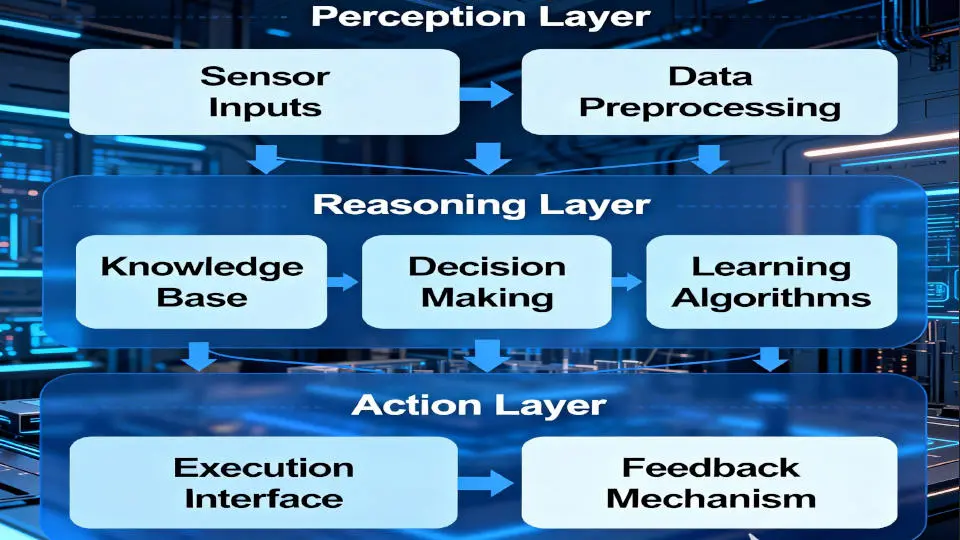
A fully functional AI Agent consists of several collaborative components that enable it to perceive, think, decide, and act. Understanding these helps us grasp how AI Agents work and where their limits lie.
One can compare the technical architecture of an AI Agent to a human cognitive system, where each component corresponds to a different function of the human mind.
The Planner is the AI Agent's "strategic brain," responsible for breaking complex tasks into executable sub-task sequences, similar to human problem-solving. The Memory System—including short-term, long-term, and episodic memory—allows the agent to maintain context and learn from past interactions.
The Tool/Action Interface is like the agent's "hands and toolkit," enabling it to connect to and invoke external tools, APIs, and services, such as database queries, web searches, or specialized software. Finally, the Executor translates decisions into specific actions, completing the final output and task delivery.
These components work together to form a complete closed-loop system from environment perception to action. Additionally, a feedback mechanism evaluates results for subsequent optimization.
AI Agent Technology Stack
- Perception: How the agent senses input (text, data, APIs);
- Memory: Storing context, past interactions, and relevant facts;
- Reasoning and Planning: Deciding which steps to take to achieve a goal;
- Action Interface: Executing tasks (tool calls, automation scripts);
- Tool Integration: Connecting to databases, calendars, and cloud services.
| AI Agent Component | Human Analogy |
|---|---|
| Perception | Senses (Eyes/Ears) |
| Memory | Long-term and Short-term memory |
| Planner | Decision-making / Thinking |
| Tool Access | Hands / Tools for tasks |
| Communication | Speech / Action interface |
Modern AI agents utilize reasoning frameworks (such as the ReAct paradigm) to interweave thinking and acting, enabling dynamic decision-making rather than static responses.
05 How Do AI Agents Make Autonomous Decisions? From Abstract to Concrete Execution
To truly understand the power of an AI Agent, it's best to observe how it handles a real-world task. Let’s take the example "Analyze last week's sales data and create a PPT report" to break down the process.
How AI Agents Work: A Step-by-Step Flow
Upon receiving a request, the AI Agent first understands the task goal, identifying it as a complex job requiring data analysis, chart creation, and document layout.
Step 1: Task Decomposition (Planning). The agent breaks the overall goal into manageable sub-tasks: ① Retrieve sales data; ② Clean and analyze data; ③ Generate charts and visualizations; ④ Write key takeaways; ⑤ Format the PPT.
Step 2: Sequential Execution. The agent calls the appropriate tools in order: uses a database query tool to get data; invokes a data analysis tool for cleaning; uses a chart generation API for visuals; utilizes a text generation model for insights; and finally uses a presentation tool for the layout.
Step 3: Evaluation and Optimization. After each step, the agent checks the quality of the result, adjusting its strategy or re-executing steps if necessary. This allows it to handle unexpected situations.
Step 4: Final Delivery. It integrates the results into a complete PPT report, ensuring consistency and coherence to meet user requirements.
Throughout this flow, the AI Agent's memory system maintains the context, ensuring smooth information transfer between steps.
Let's look at a practical workflow to demystify how AI agents operate.
Example Task:
Analyze last week's sales data and generate a PowerPoint report.
AI Agent Workflow
- Understanding the Goal: Interpreting the user's intent.
- Data Retrieval: Accessing the sales dataset from cloud storage.
- Data Cleaning: Normalizing the data and filtering outliers.
- Analysis and Insights: Calculating trends and identifying popular products.
- Charts and Visualization: Generating charts.
- Drafting Report Content: Summarizing the analysis results.
- PPT Generator: Compiling a structured slide presentation.
- Delivery: Saving/reporting or emailing the report to the requester.
This process demonstrates how multiple reasoning and action steps combine into a coherent workflow. Unlike simple prompt-response systems, the agent can autonomously manage the entire process and adapt as needed (e.g., handling missing data).
06 What are the best AI agent frameworks? Comparison of Major AI Agent Frameworks
As AI Agent technology matures, several development frameworks have emerged to help developers build applications more efficiently. These frameworks focus on different needs and user scenarios.
For developers, there are currently five mainstream frameworks: LangChain, LangGraph, CrewAI, Semantic Kernel, and AutoGen. These provide varying levels of abstraction.
The table below provides a comprehensive comparison:
| Framework | Key Features | Best For | Learning Curve |
|---|---|---|---|
| LangChain | Highly flexible, rich ecosystem, modular design | Customizable AI apps, prototyping | Medium (Python required) |
| LangGraph | LangChain extension; supports stateful, multi-agent systems | Complex interactive systems, multi-agent collab | High (requires LangChain knowledge) |
| CrewAI | Role-based collaboration; mimics human team structures | Role-specific tasks, project management simulation | Medium (intuitive concepts) |
| Semantic Kernel | Enterprise integration, multi-language, security-focused | Enterprise app integration, AI-enabling legacy systems | Medium (rich documentation) |
| AutoGen | Powerful multi-agent conversation and task completion | Complex multi-agent systems, research experiments | High (complex configuration) |
In practice, we found that LangGraph is more stable for state control when building multi-agent prototypes, but debugging costs are higher.
If you want to build a prototype quickly, start with LangChain. If you need a complex team collaboration system, CrewAI is the better choice.
For general users and business applications, platforms are available that allow non-technical users to leverage AI Agent capabilities.
These platforms offer user-friendly interfaces and pre-configured solutions. Leading platforms include:
- Google Vertex AI Agent Builder: Enterprise-grade AI agents with cloud and API integration.
- AWS Autonomous Agents: Focused on security and DevOps tasks.
- Third-party Agents (e.g., Manus): Highly autonomous task executors.
| Platform | Target User | Advantage |
|---|---|---|
| Vertex AI | Developers and Enterprises | Scalable, secure |
| AWS Agents | Cloud Ops teams | Integrated with AWS tools |
| Manus | General users | Autonomous execution |
- The LangChain framework has a moderate learning curve but offers high customizability.
- The Vertex AI platform provides no-code/low-code tools for business users.
From the comparison above, we can see that each AI Agent framework has its own characteristics and use cases. Therefore, there is no single best AI Agent framework; there is only the most suitable AI Agent framework based on the specific scenario requirements.
07 What Are AI Agents Used For? Real-World AI agent use cases
The value of AI Agents is ultimately realized in practical applications. They excel in scenarios requiring repetitive, structured decision-making and multi-step process handling, which is why enterprise AI agents are increasingly adopted to automate workflows, streamline operations, and support data-driven business decisions at scale.
Content Creators: Boosting Efficiency and Quality
Creators often struggle with the pressure of planning, creating, and posting across multiple platforms. In practice, AI Agents can significantly reduce production time.
Traditionally, creators manually search for materials, plan schedules, write content, design graphics, and post to various platforms. An AI Agent can automatically analyze trending topics, generate outlines, assist with drafting/layout, match visuals, and schedule posts, allowing the creator to focus on the core creative idea.
Enterprise Operations: Automated Data Processing and Reporting
Operations teams need to analyze business data and generate reports regularly. AI Agents can reduce report generation time from hours to minutes.
Without an agent, staff must export data from multiple systems, manually clean it, and create charts—a process prone to error. An AI Agent can automatically connect to data sources, perform analysis, generate visualizations, write insight reports, and send them to stakeholders.
Personal Productivity: Intelligent Schedule and Task Management
Personal users often face information overload. AI Agents can save users 1-2 hours per day.
Traditionally, users manually organize emails, meeting notes, and to-dos. An AI Agent can automatically sort information, extract action items, intelligently schedule meetings, and track task progress, enabling users to focus on high-value work.
Customer Support: 24/7 Intelligent Problem Solving
Support teams face high volumes of repetitive queries. AI Agents can handle 70-80% of common questions, freeing human agents for complex cases.
An AI Agent can understand natural language queries, retrieve from a knowledge base, provide accurate solutions, and automatically escalate complex issues, providing a consistent and efficient customer experience.
08 Current Challenges and Strategies
Despite significant progress, AI Agents still face several challenges in practical application.
AI "Hallucinations" and Decision Errors
During complex planning, an agent might generate illogical steps or make decisions based on false info. The strategy is to strengthen verification modules, adding human-in-the-loop oversight or cross-validation at key decision points.
Efficiency and Cost
Frequent LLM calls and tool usage can lead to slow speeds and high operational costs. Solutions involve optimizing task planning to reduce unnecessary calls and using more efficient models and caching strategies.
Security and Control Risks
Risks include infinite loops or unauthorized actions (like sending rogue emails). This requires setting clear Guardrails, limiting the agent’s scope and permissions, and establishing audit trails.
Evaluation Difficulty
There is no unified standard for quantifying an agent's "execution ability." The industry is developing observability-based evaluation frameworks to monitor performance via key metrics.
Technological Limitations
These also include the potential inability of AI agents to handle tasks requiring deep empathy or complex interpersonal interactions. Caution is also needed when applying AI agents in situations involving high ethical risks or unpredictable physical environments.
In real business scenarios, we find that the most common issue isn't model capability, but rather tool permissions and failure rollbacks.
09 Future Trends and Value for Individuals
AI Agent technology will continue to evolve, offering more utility to the average person.
More Autonomous and Reliable
Agents will move from "needing detailed instructions" to "understanding vague intent," planning and executing tasks based on high-level goals.
Multimodal Integration
By integrating multimodal capabilities, AI Agents will be able to see, hear, and interact with graphical user interfaces, becoming a true interface for the digital world.
Scale and Platformization
The rise of "Agent App Stores" and "Agent Cloud Services" will allow users to download and use specialized agents as easily as mobile apps.
Specialization and Verticalization
Expert-level agents will emerge in specialized fields like healthcare, law, and finance, providing high-quality professional services.
The most exciting direction is Human-AI Collaboration: AI Agents will shift from "replacing humans" to "augmenting humans," becoming a seamless extension of our capabilities.
For the average person, future AI Agents will function more like personalized digital colleagues or assistants. They will understand your work habits, preferences, and needs, proactively assisting in the completion of various tasks.
These intelligent assistants will seamlessly integrate into daily life, managing personal finances, planning healthy lifestyles, supporting children’s education, and optimizing household chores, truly enhancing both quality of life and efficiency.
As technology matures and costs decline, AI Agents will become more accessible and democratized. They will no longer be exclusive tools for large enterprises but smart partners available to everyone.
Predictions from authoritative organizations like Gartner suggest that the adoption rate of AI Agents in enterprises will reach 33% by 2028. This figure represents the inevitable outcome of technological maturity—AI Agent architectures driven by Large Language Models (LLMs) have become the standard paradigm for building intelligent applications.
Examples like Amazon’s Rufus shopping assistant, Walmart’s employee collaboration tools, and Shopify’s merchant decision-support systems demonstrate the tangible value of Agentic AI in business operations. AI Agents are evolving into digital workers capable of proactively understanding complex business needs, planning multi-step tasks, and invoking various APIs.
10 Frequently Asked Questions (FAQ)
Q1: Are AI Agents and ChatGPT the same thing?
No. ChatGPT is a general conversational AI, while an AI Agent is a software system centered on "completing goals." Agents can plan tasks and call tools, whereas ChatGPT primarily generates text.
Q2: Do AI Agents have to be connected to the internet?
Not necessarily, but for real-world business tasks, most high-value agents require internet access to call external tools, APIs, or databases.
Q3: What is the difference between an AI Agent and RPA?
RPA follows fixed rules ("follow the script"). AI Agents can understand intent, plan dynamically, and handle uncertainty.
Q4: How does an AI Agent "make decisions"?
It uses LLMs for reasoning and planning, combined with memory systems and feedback to evaluate each step.
Q5: Can an AI Agent get stuck in an infinite loop?
Yes, if poorly designed. Practical applications use "Guardrails" like maximum step limits and manual intervention points to prevent this.
Q6: Will the AI Agent "remember" my data?
This depends on the implementation. Short-term tasks use temporary context; long-term memory depends on the system's design and privacy permissions.
Q7: Should I start using an AI Agent now?
If your work involves repetitive tasks or switching between many tools, they are already valuable. For highly creative or emotional work, they are better as assistants.
Q8: Which industries are best suited for AI Agents?
Those with clear processes: content creation, operations analysis, customer support, software development, and e-commerce.
Q9: Will AI Agents replace human jobs?
In the short term, they are more likely to "augment" rather than replace. Humans remain essential for judgment, creativity, and empathy.
Q10: Do I have to use LangChain to build one?
No. While popular, there are many alternatives like LangGraph, Semantic Kernel, and AutoGen.
Q11: Is the barrier to entry high for developing AI Agents?
For developers, frameworks have lowered the bar. For non-technical users, low-code platforms allow for immediate use of ready-made agents.
References:
[1]: https://cloud.google.com/discover/what-are-ai-agents "What are AI agents? Definition, examples, and types."
[2]: https://en.wikipedia.org/wiki/Artificial_human_companion "Artificial human companion"
[3]: https://en.wikipedia.org/wiki/Open_Agent_Architecture" Open Agent Architecture"
[4]: https://en.wikipedia.org/wiki/Procedural_reasoning_system" Procedural reasoning system"
[5]: https://en.wikipedia.org/wiki/Agentic_AI "Agentic AI"
[6]: https://www.barrons.com/articles/nvidia-stock-ceo-ai-agents-8c20ddfb "Nvidia CEO Says 2025 Is the Year of AI Agents"
[7]: https://www.salesforce.com/ap/agentforce/ai-agents/ "AI Agents: Definition, Types, Examples | Salesforce"
[8]: https://www.leanware.co/insights/ai-agent-architecture-concepts-components-best-practices "AI Agent Architecture: Concepts, Components & Best Practices"
[9]: https://www.geeksforgeeks.org/artificial-intelligence/ai-agent-frameworks/ "AI Agent Frameworks - GeeksforGeeks"
[10]: https://www.reddit.com//r/AI_Agents/comments/1n09f6b "Exploring AI agents frameworks was chaos… so I made a repo to simplify it (supports OpenAI, Google ADK, LangGraph, CrewAI + more)"
[11]: https://www.techradar.com/pro/google-cloud-is-making-its-ai-agent-builder-much-smarter-and-faster-to-deploy "Google Cloud is making its AI Agent Builder much smarter and faster to deploy"
[12]: https://m.economictimes.com/tech/artificial-intelligence/aws-rolls-out-autonomous-ai-agents-to-bolster-nvidia-led-cloud-push/articleshow/125770074.cms "AWS rolls out autonomous AI agents to bolster Nvidia-led cloud push"
[13]: https://en.wikipedia.org/wiki/Manus_%28AI_agent%29 "Manus (AI agent)"
[14]: https://www.reddit.com//r/MachineLearning/comments/1cy1kn9 "[D] AI Agents: too early, too expensive, too unreliable"
About the Author
This content is curated by the NavGood Editorial Team. NavGood is a platform dedicated to the AI tool ecosystem, tracking the development of AI Agents and automated workflows.